Consistent API Responses — Why They Matter and How to Implement Them in NestJS
Every endpoint returning the same envelope, success or failure — the response shape worth settling on, and the global interceptor and exception filter that enforce it in NestJS.
As a frontend engineer, one of my biggest pain points over the years has been dealing with inconsistent API responses.
Sometimes a successful response looks like:
{
  "data": [...],
  "meta": {...}
}
Other times it’s:
{
  "result": [...],
  "pagination": {...}
}
And on errors? Even worse — sometimes it’s { "error": "Something went wrong" }, other times { "message": "Invalid request" }.
Inconsistency like this isn’t just annoying — it slows down development, increases bugs, and makes error handling harder.
This post is about why API response consistency matters, and how you can enforce it in NestJS using a global interceptor and exception filter.
Why Consistency Matters
Whether you’re building an internal API for your team or a public API for thousands of developers, a consistent response structure means:
- Predictable parsing – Frontend doesn’t need to guess the structure.
- Simplified error handling – One handler for all endpoints.
- Easier documentation – You can define the schema once and reuse it everywhere.
- Better DX (Developer Experience) – Less mental load, faster iteration.
My Standard API Response Structure
Here’s the format I like to use:
{
  "method": "GET",
  "path": "/users",
  "timestamp": "2025-08-15T10:00:00.000Z",
  "statusCode": 200,
  "success": true,
  "data": [],
  "meta": null,
  "error": null
}
And for errors:
{
  "method": "GET",
  "path": "/users",
  "timestamp": "2025-08-15T10:00:00.000Z",
  "statusCode": 400,
  "success": false,
  "data": null,
  "meta": null,
  "error": {
    "type": "Bad Request",
    "message": "Validation failed",
    "errors": {
      "email": ["Email is required"]
    }
  }
}
The API Response Flow
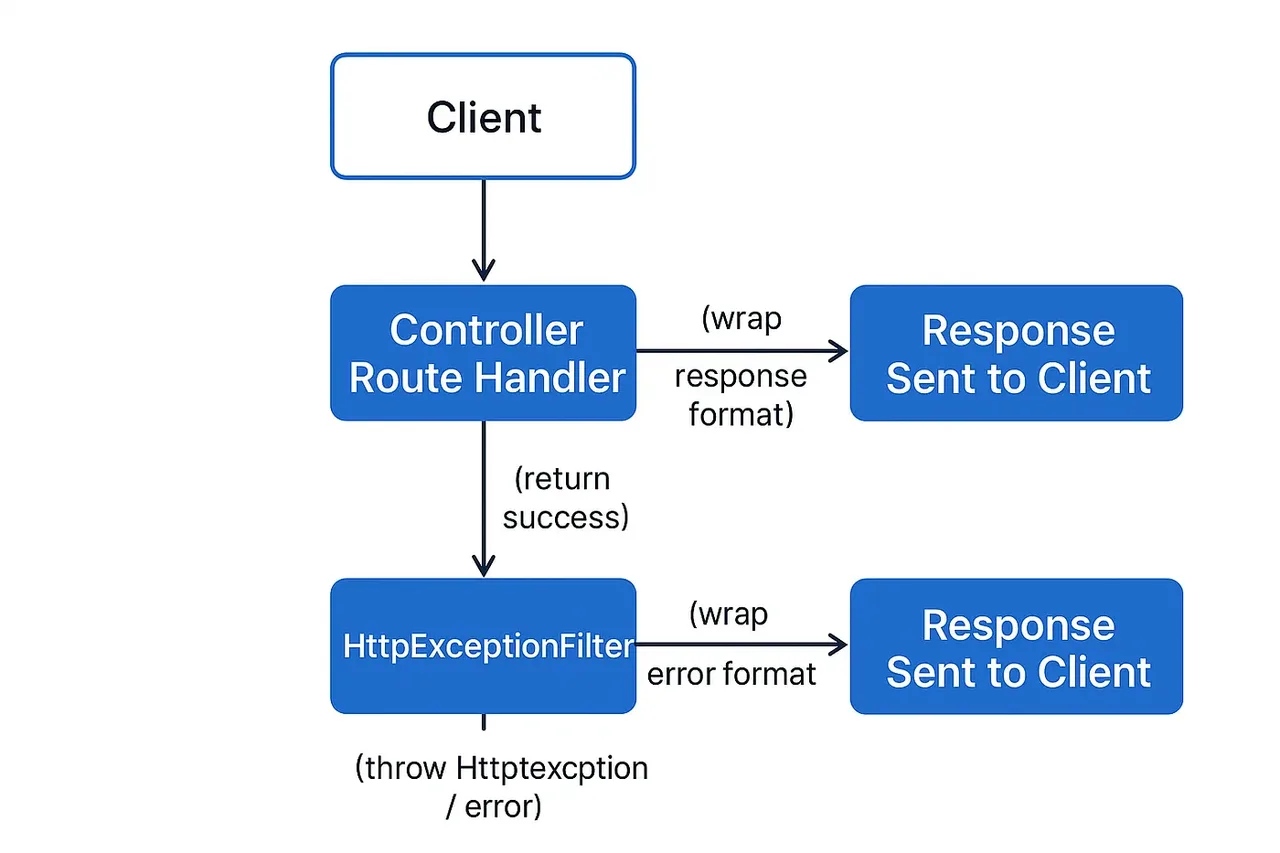
Here’s the basic lifecycle of an API request with consistent formatting:
- Request Received — API gets the HTTP request from client.
- Business Logic Execution — Controller/service handles the main process.
- Response Interceptor — Wraps all successful responses in the same format.
- Exception Filter — Catches all errors and formats them consistently.
- Final Response Sent — Frontend always receives predictable JSON.
Implementation in NestJS
We can enforce this consistency globally using two things:
- A ResponseInterceptor for success responses
- An HttpExceptionFilter for errors
Global ResponseInterceptor
import {
  CallHandler,
  ExecutionContext,
  HttpException,
  Injectable,
  NestInterceptor,
} from "@nestjs/common";
import { catchError, map, Observable, throwError } from "rxjs";
import { Request, Response } from "express";

@Injectable()
export class ResponseInterceptor implements NestInterceptor {
  intercept(context: ExecutionContext, next: CallHandler): Observable<any> {
    const request = context.switchToHttp().getRequest<Request>();
    const response = context.switchToHttp().getResponse<Response>();

    return next.handle().pipe(
      map((data) => this.handleSuccess(request, response, data)),

      catchError((err) => {
        const statusCode = err instanceof HttpException ? err.getStatus() : 500;
        return throwError(() => new HttpException(err, statusCode));
      }),
    );
  }

  private handleSuccess(request: Request, response: Response, data: any) {
    const responseData = {
      method: request.method,
      path: request.url,
      timestamp: new Date().toISOString(),
      statusCode: response.statusCode,
      success: true,
      data: data,
      meta: null,
      error: null,
    };

    if (data?.data && data?.meta) {
      responseData.data = data.data;
      responseData.meta = data.meta;
    }

    return responseData;
  }
}
Global HttpExceptionFilter
import { ArgumentsHost, Catch, ExceptionFilter, HttpException } from "@nestjs/common";
import { Request, Response } from "express";
import { STATUS_CODES } from "http";

@Catch(HttpException)
export class HttpExceptionFilter implements ExceptionFilter {
  catch(exception: HttpException, host: ArgumentsHost) {
    const ctx = host.switchToHttp();
    const request = ctx.getRequest<Request>();
    const response = ctx.getResponse<Response>();

    const status = exception.getStatus();
    const exceptionResponse = exception.getResponse() as any;

    const error = {
      type:
        STATUS_CODES?.[status] || exceptionResponse.response?.error || exception.name || "Error",
      message:
        status === 500
          ? "Internal Server Error"
          : exceptionResponse?.response?.message || exception.message,
      errors: exceptionResponse?.response?.validation || null,
    };

    const responseData = {
      method: request.method,
      path: request.url,
      timestamp: new Date().toISOString(),
      statusCode: status,
      success: false,
      data: null,
      meta: null,
      error,
    };

    response.status(status).json(responseData);
  }
}
Applying Globally in main.ts
import { NestFactory } from "@nestjs/core";
import { AppModule } from "./app.module";
import { ResponseInterceptor } from "./interceptors/response.interceptor";
import { HttpExceptionFilter } from "./filters/http-exception.filter";

async function bootstrap() {
  const app = await NestFactory.create(AppModule);

  app.useGlobalInterceptors(new ResponseInterceptor());
  app.useGlobalFilters(new HttpExceptionFilter());

  await app.listen(3000);
}
bootstrap();
The Result
With this setup:
- Every success response will have the same structure.
- Every error will follow the same format.
- Your frontend engineers will love you (or at least stop complaining 😆).
Bonus: You can easily add meta for pagination or errors for validation without changing the overall shape.
Key takeaway: Consistency is more important than the exact structure. Once you decide the shape, enforce it across all endpoints.